
A STARC DIFFERENCE
Derek Pringle assesses his moment of the day on a remarkable Saturday in Perth

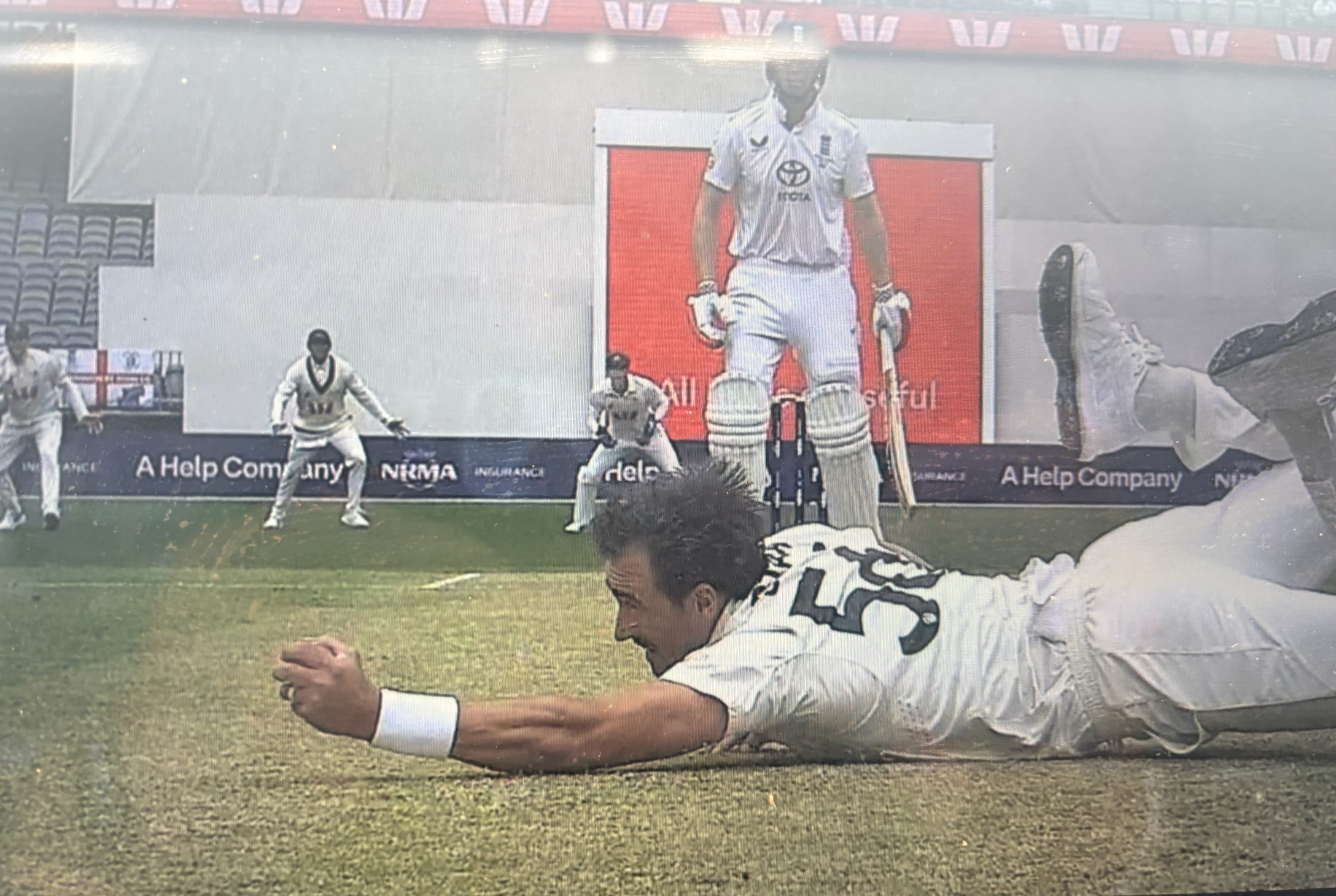
A duck, let alone a brace of them, can be mortifying for batters but whatever emotions Zak Crawley felt over his second blob of the Test, he surely had a begrudging admiration for the skills Mitchell Starc showed when dismissing him in England’s 2nd innings.
Starc is a gangly left-arm pace bowler whose pace and fitness bely his 35 years. But those years have varnished him with great experience, including the need to make sure his first ball is not a loosener but on the money, in both pace and direction.
When the timing is good, Starc is 90mph. When the technique is good, there is in-swing to right-handers. His stock ball, though, is angled across the right-hander. One of those did for Crawley in the first innings, a booming drive ending up in the mitts of first slip.
I won’t pretend to know what goes on in Starc’s mind, he’s both a fast bowler and an Aussie (so many will claim not a lot), but for whatever reason in that 2nd innings he bowled four stock balls to Crawley before running his fingers under the fifth, undercutting it, something that made it imperceptibly slower than its predecessors.
It was the same ball that got Ben Stokes in England’s first innings, that one cutting back through the gate to hit the stumps. The effect here was that Crawley, who likes to get on the front foot and hit through the ball, shaped to do just that but realised he was going to be early so stopped his shot. The resultant poke was unseemly but looked safe (it was heading towards mid-off) until Starc in a incredible feat of athletic dexterity dived to his left, telescoped his left-arm, and held on to complete a remarkable catch.
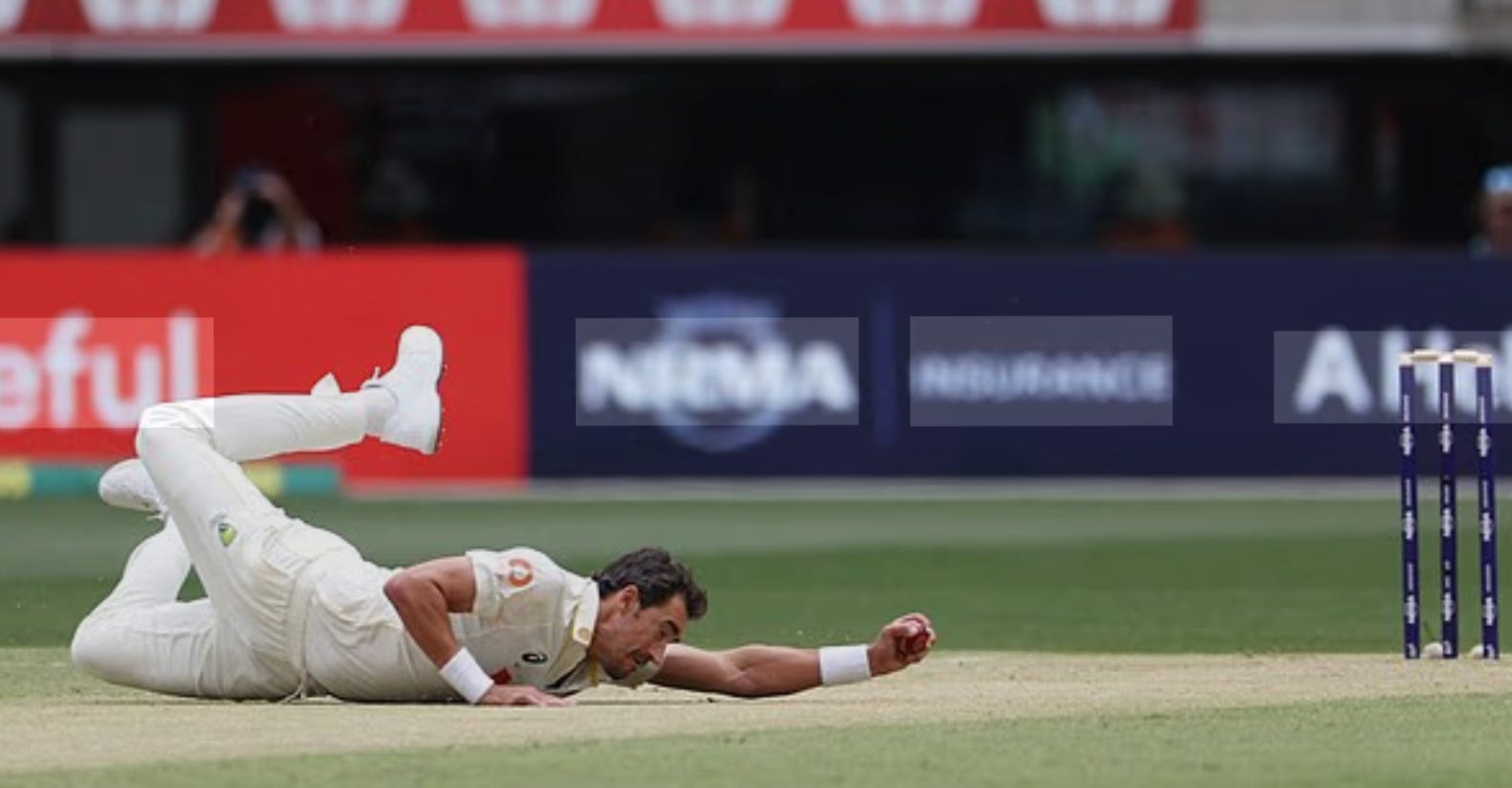
I’ve taken a few decent caught and bowleds in my time but Starc’s was at the limits of what is possible for bowlers given the laws of the universe and the laws of the game. Let’s take the latter. Bowlers are not allowed to run down the pitch in their follow-through, which means Starc, who was bowling over the wicket, would have been heading off towards mid-wicket after releasing the ball. To be able to shift his entire body weight in the other direction, in a fraction of a second, is a physical feat that defies the physics of momentum.
Having got across to intercept, it wasn’t a lucky grab. Crawley’s stab was a miscued, so Starc had to adjust his left hand to cup the ball. That wasn’t the end of it either. His outstretched hand with ball in it hit the pitch hard, or at least his wrist did though he’d already turned it so the ball wouldn’t be grounded. Had his elbow hit the turf, his hand would have opened as a reflex and the catch would have been spilt.
This was a moment of utter brilliance, involving instinct, quick reaction, unbelievable co-ordination and honed technique. It also got Australia on their way after conceding a 40-run deficit to England on first innings. Starc finished with 10-wickets, a haul which, in concert with Head’s remarkable hundred, helped Australia win this opening Ashes Test for in two days.
SUBSCRIBE TO THE CRICVERSE FOR DAILY ASHES ANALYSIS AND AD-FREE PODCASTS
 | A guest post by
|