CLICKBAIT SALVATION
County cricket's future sustainability is via YouTube

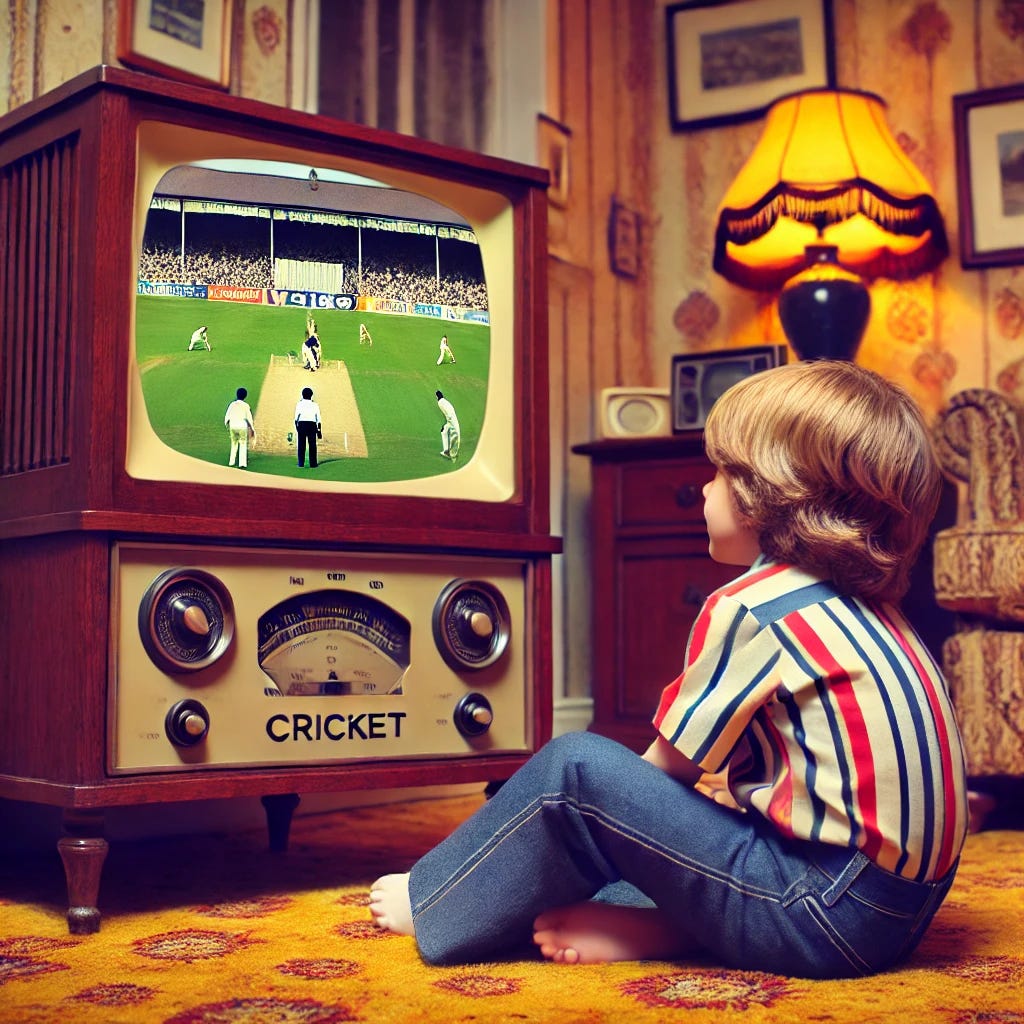
If you’re of a certain age and disposition you’ll remember the kind of scene above: sat infront of the telly during the school holidays watching cricket on the BBC while your parents were at work or doing the shopping (at least until your dad got home and made you wash the car.) There was nothing much else to watch – Hector’s House, Crossroads or a Carry On movie. Test cricket was a saviour. It kept me engaged for hours. Sad though it is to report I even used to score those games. With a Geoff Boycott innings I ran out of space for all the dots.
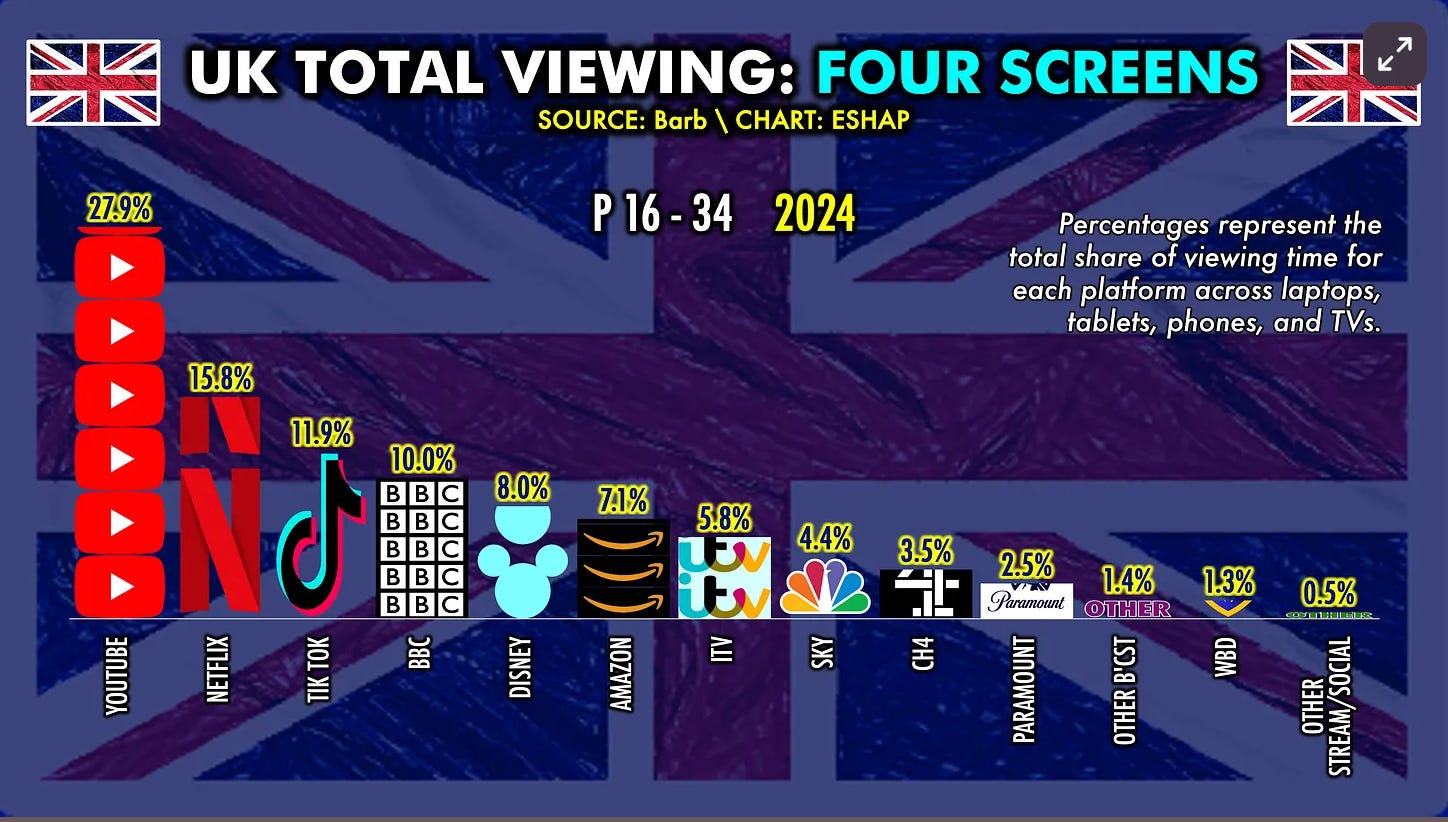
Modern viewing habits, of course, are rather different. A new report Mine the Gap published today by Evan Shapiro, referred to as ‘the media universe cartographer’ reveals something that we were already conscious of - a hastening in the UK of the decline in viewing linear broadcasting channels and an acceleration of consumption of streaming and ‘social video’. This evolution is driven by the digital-first population (those born from the 1990s onwards) who you could lump together as the four-screen generation (often with TVs, laptops, tablets and smartphones at their disposal.)
The most interesting development perhaps, is that the ‘social video’ viewing – basically YouTube – is dominating the landscape even on a conventional TV. The graph below demonstrates that in the 16-34 age group YouTube outstrips every other channel or broadcast service in viewing hours across the four screens. Netflix and YouTube are in first and second place in viewing share for that age group on TV screens alone. BBC are not far behind, but others such as ITV, Channel 4 and Sky are also rans. Its nor surprising that Channel 4 (and laterly ITV) has decided to lump a lot of their older programming on YouTube.
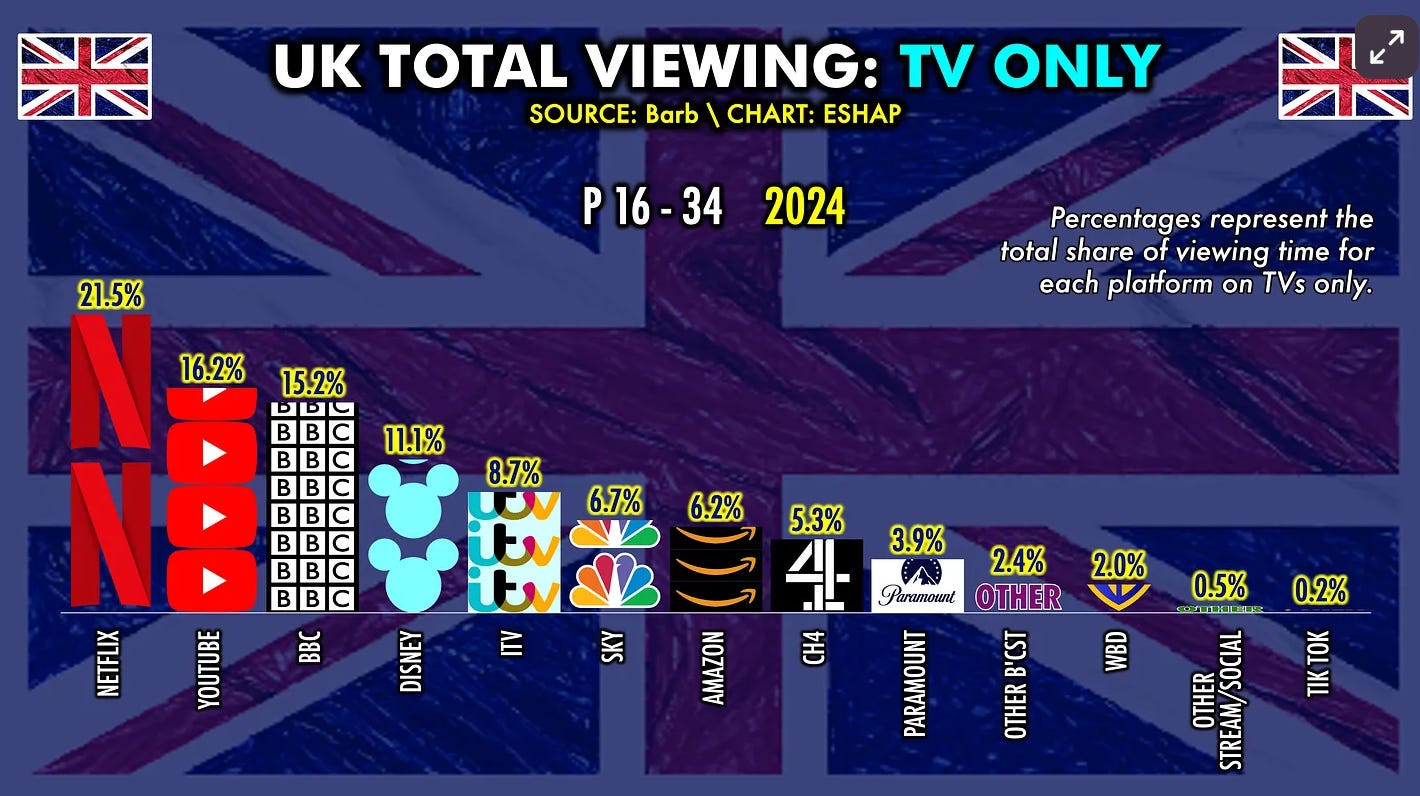
.In the 35 plus age group, BBC and ITV are still comfortably holding top spots on TV’s alone, but across the four screens social video is rising fast – watch time of YouTube is in third place commanding over 11% of the older demographic’s screen time. This is what Shapiro says about the situation:
“With Millennials now a driving force in the 35+ demo, with Gen Z taking centre stage in the culture and workforce, and Generation A now dictating more and more in-home TV consumption, the clock on Broadcast and Pay TV’s pole positions in the UK TV industry is running out, rapidly.”
What does this all mean for English cricket? It means that they cannot rely on Sky and BBC money in the future (hence the importance of the Hundred franchise sales). It also means that counties with a strong YouTube presence for their live stream and other content have a better chance of becoming sustainable than those that don’t. [YouTube is now accepted as the world’s second largest search engine after its parent, Google.] Vitally, viewer data is attainable, and priceless.
Total YouTube views across a county cricket season run into tens of millions (we estimated close to 30m in 2023). There is money to be made here. Not necessarily gold or silver, but certainly bronze. Somerset are a great case study. Their head of marketing and digital, Ben Warren, recently posted on Twitter that “with 1.2m social media followers, Somerset is the most followed sports club in the UK (excluding football)”. He also suggested that last year’s dramatic Somerset v Surrey county championship match (the one where Jack Leach took the final wicket in the last over to keep Somerset’s championship hopes alive) is “the most watched county championship match of all time.” With over 1 million viewers clocked up on YouTube over the four days, he is surely right there.
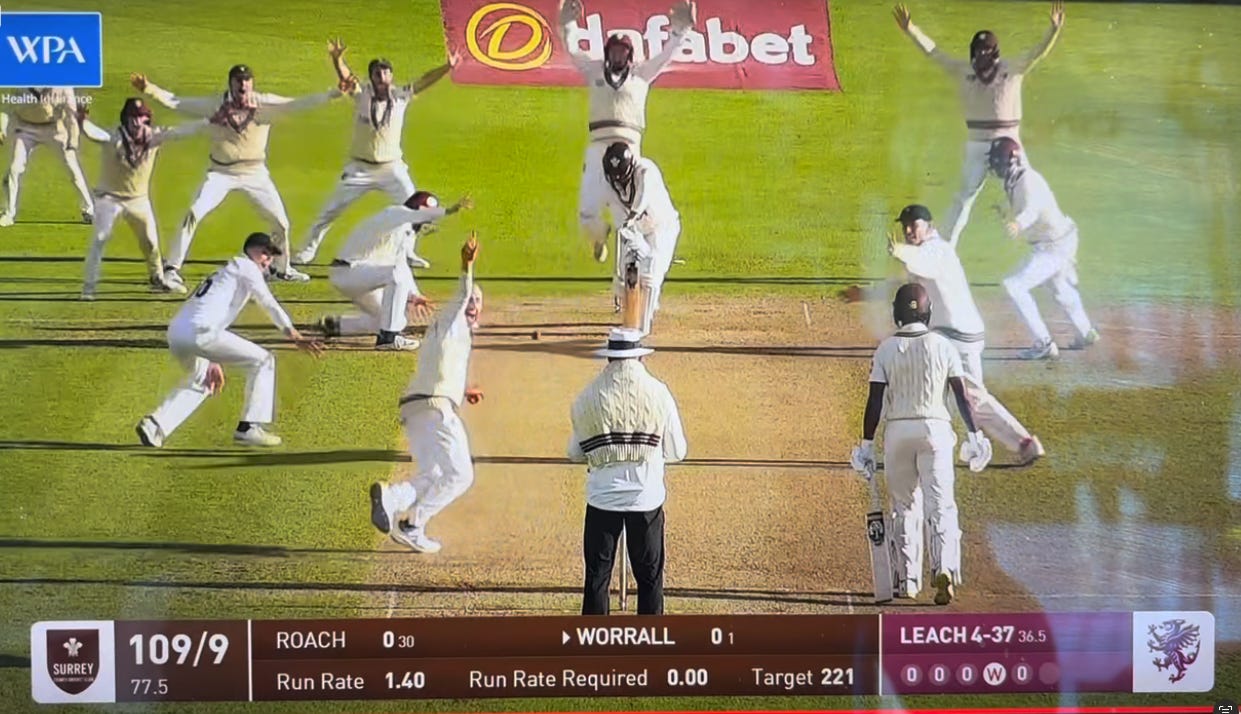
Jack Leach traps Dan Worrell lbw in the last over of Somerset’s final home game
This has all led to Somerset consistently making healthy six-figure profits and generally punching above their weight off the field, as well as on it. How have they done it? “Authenticity,” says Warren, who has been at the club ten years and was the first to professionalize a county’s social media operation. “We’ve tried to give our coverage ‘personality’ – get behind the scenes, make it entertaining,” he says. “We gave the team a camera getting them to film in the dressing room and on the team bus and made a documentary ‘Behind the Wyvern’. We introduced sponsored themed ideas to the live coverage, getting the commentators to choose a man of the match and calling it the Cairnhill Moment of Steel [after their Scottish steel sponsor.] We’ve done a Spin a Wheel Trade Nation challenge. Of course the cricket comes first, but we wanted to make our stream fun and engaging too.”
And profitable. The club has doubled its commercial inventory to £1.3m, membership is holding solid at 6,500 and they have seen a take up of 750 for their newly created women’s team membership. The live stream has been an excellent platform for marketing the club and advertising events. All they need now is that elusive championship trophy. Although their commercial success proves that winning is not the be-all and end-all of modern sport. Think entertainment first, silverware second. That’ll get those Gen Z’ers off TikTok – for a few minutes. Enough time to get their data anyway.