
THE OBLITERATORS
A new breed of ultra-attacking batters is taking Test match runmaking to new levels of audacity

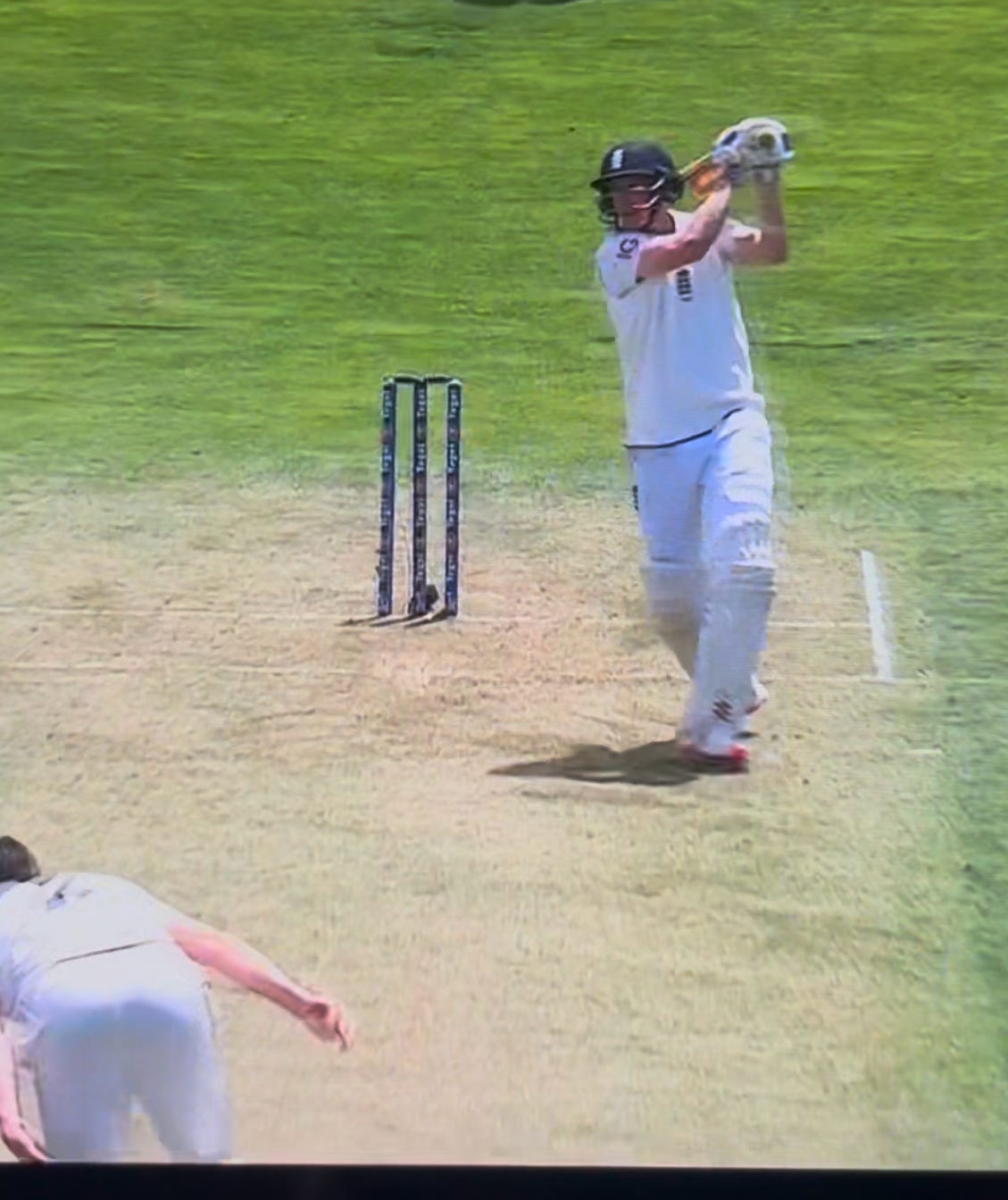
Cricket’s greatest batters are disruptors. Each had their own game-changing philosophy, going right back to WG Grace, the first to use forward and back play. Don Bradman played almost exclusively back, using his pad as a second line of defence, knowing that, until 1937 you could not be out lbw if the ball pitched outside off-stump. (Incredibly he was only given out lbw three times in his first ten years as a Test player.)
Viv Richards eased across to the offside and whipped balls on the stumps through mid-wicket. Sachin Tendulkar pioneered the checked-drive, bunting the good-length ball back past the bowler with a controlled punch. He dissected bowling attacks. Brian Lara destroyed them, mimicking Garfield Sobers with a backlift like a periscope and a flamboyant follow-through. Kevin Pietersen came at the quicks and hit them over mid-wicket off one leg.
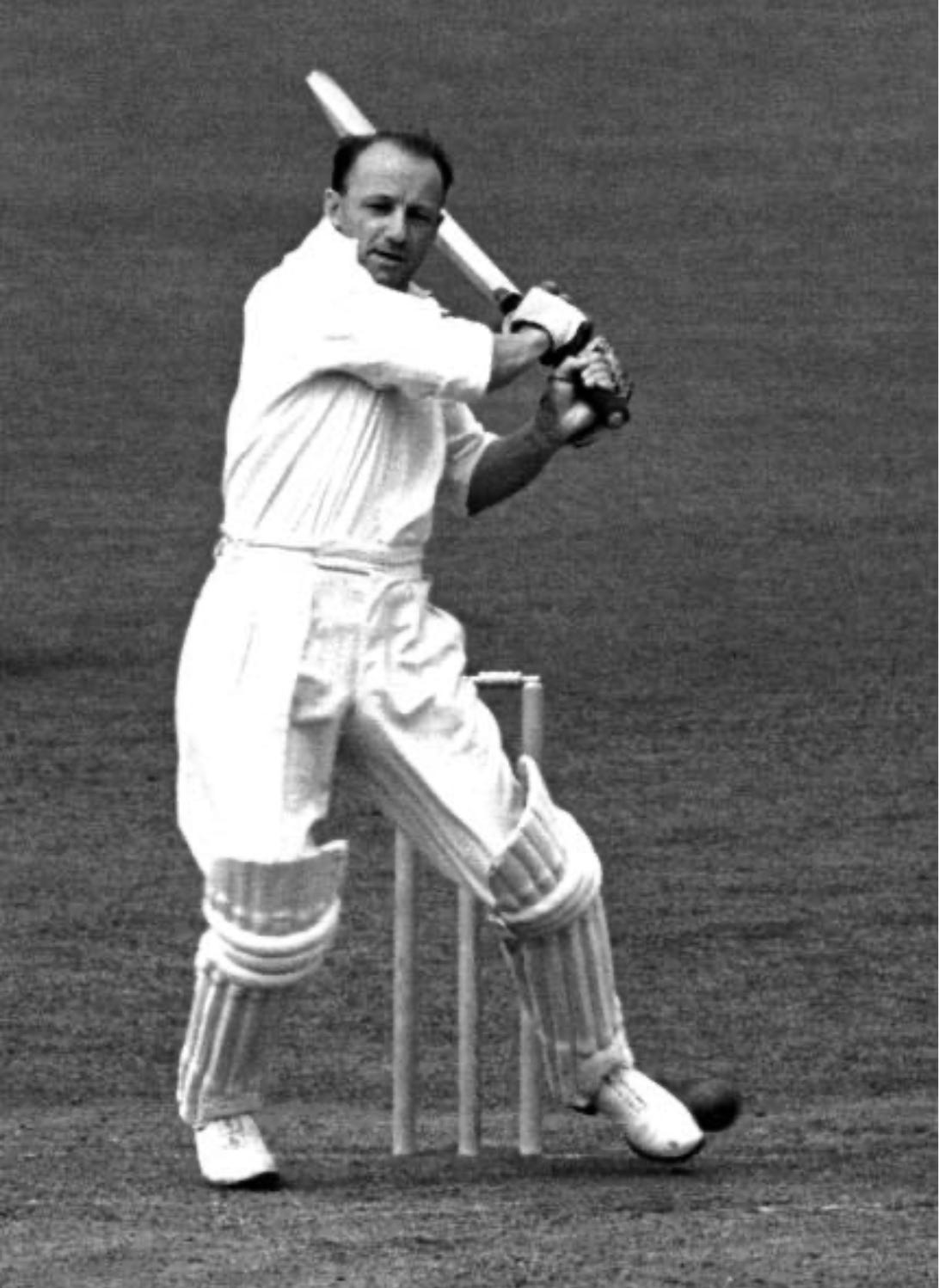
Don Bradman scored predominantly off the back foot.
More recently we have had the ‘trigger boys’, players like Steve Smith and Joe Root who have a particular pre-delivery shift back and across the stumps (Smith’s is much more pronounced) to enable them to ‘own’ the bowlers’ persistent channel just outside off-stump. For almost a decade Smith drove bowlers to distraction with his method of unerringly hitting everything on the stumps past square leg. Most, if not all these players - and their imitators - looked to get across to cover the stumps with their legs and hit anything straight to the onside.
Now, as we discuss in the ANALYST PODCAST we have two destructive players doing the exact opposite. Harry Brook and Travis Head prefer to stay legside of the ball and flay it through, or over, the offside. They don’t seek to ‘own’ the off-stump channel, they try to obliterate it. It is a significant departure from batting conventions and, just as Richards, Pietersen and Smith in particular did before, is again transforming the game. It is laden with risk as this approach is mostly premeditated, leaving the stumps largely unprotected, and the head ends up not in line with the ball (see Brook below) which has always been one of the first rules of batting (ie make sure your head is going towards the ball, even if your feet don’t.)
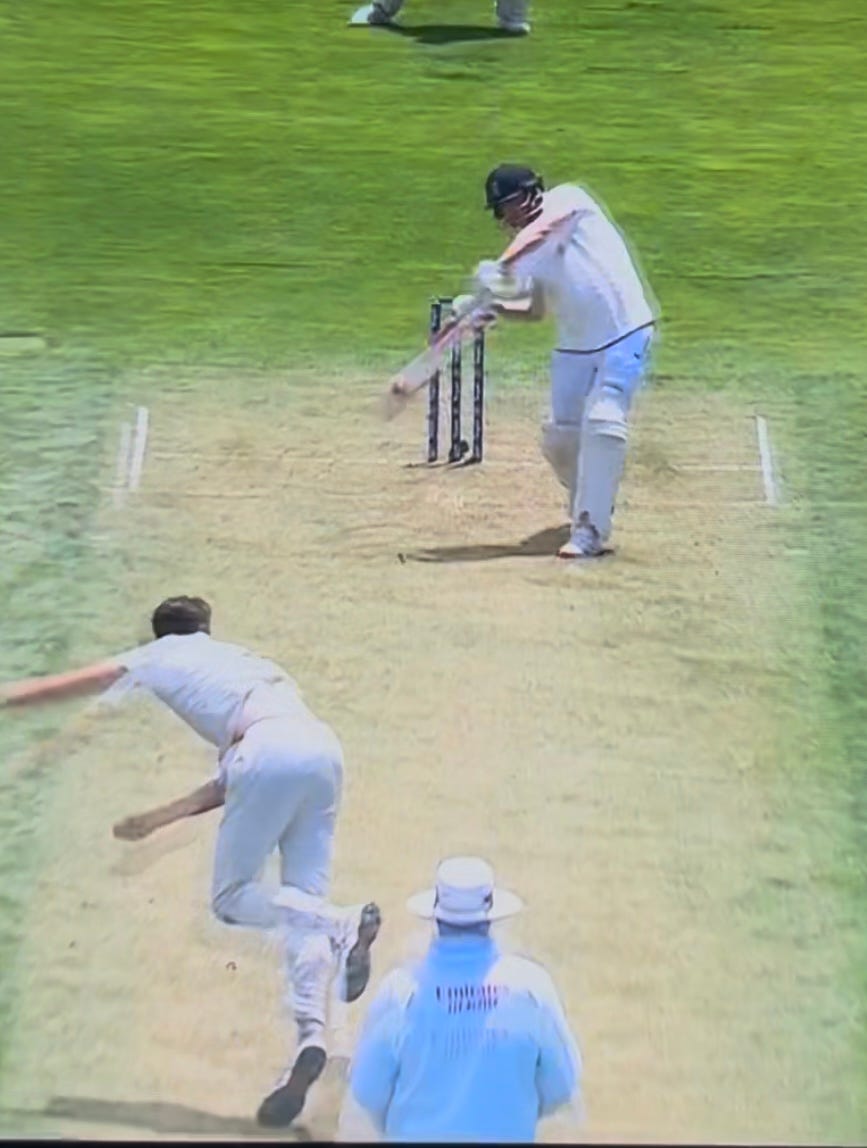
Harry Brook carves Will O’Rourke over extra cover for six in Wellington
The aim of this batting method is to free the arms and enable a full swing of the bat, not to just survive or negotiate balls in that fourth stump channel, but to assault them. As Brook said after his brilliant 123 in Wellington – “I thought the best mode of defence was attack.” Brook’s finishing position after some of these shots is extraordinary, but despite all the extravagant movement, the head remains still and upright, eyes level, which is vital (see above.)
He is, as Michael Atherton mentions in today’s Times, already showing signs of greatness; this skill – to be able to hit a good length, 88mph delivery from New Zealand’s Will O’Rourke over extra cover for six while standing a yard outside leg-stump - being one of them. His expertise in this area reminds me of a top clay-pigeon shooter I once interviewed. Richard Faulds was a double-trap clay junior champion. I had a go on the shooting range at the back of his Wiltshire home one day, and predictably missed everything. He then stood beside me, while I held the rifle, moved the barrel left or right as the clay flew through the air, and said ‘fire.’ I/we hit 8 out of 10. Faulds went on to break the double-trap world record and won Olympic gold in Sydney.
Faulds was clearly a sportsman of extraordinary talent, able to hit the target even when metaphorically shooting from the hip, and Brook is the same. He is now third in the list of all-time highest Test batting averages (of batters who’ve played more than 20 Tests) – averaging 61.62. He has soared ahead of the South African great Graeme Pollock who himself was a game-changer, a 6ft 4in colossus standing legs wide apart and delivering meaty blows from that immoveable position at the crease. (I spent fruitless hours trying to persuade South African schoolboys who idolised Pollock not to stand like this.) Brook also now has the highest strike rate of any top batter in Test history (88.57) - higher even than the brilliant Virender Sehwag or the bludgeoning Shahid Afridi. Head’s strike rate is 66.16. It will be fascinating to see how the bowling brotherhood respond to their increasing dominance.
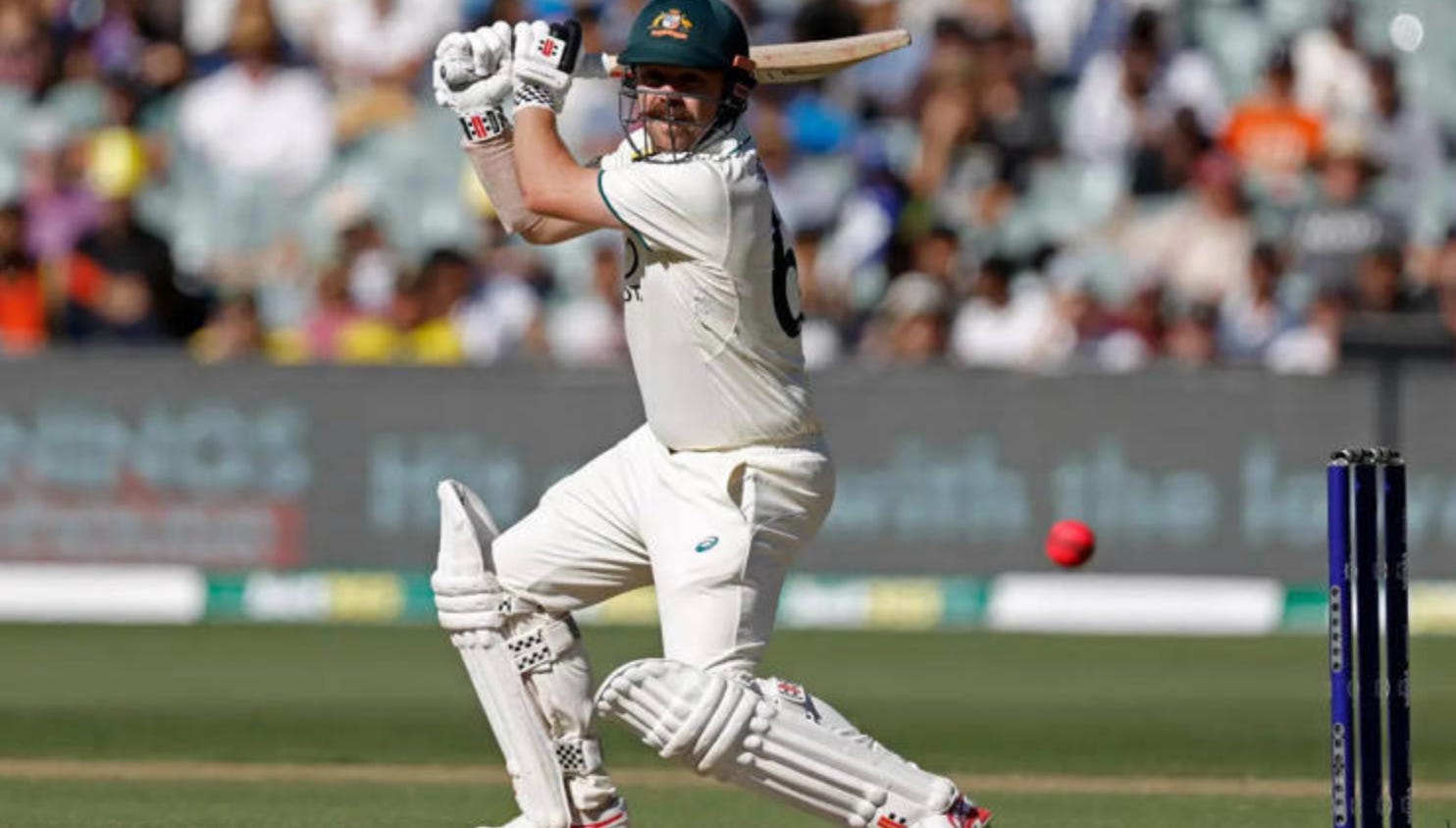
Travis Head crashes another Indian delivery through the offside in Adelaide
LISTEN TO OUR EXCLUSIVE ‘HEADHUNTERS’ SERIES ON THE 1974/5 ASHES HERE
I think it is better to take stick of Brook and Head after 100 matches. We are seeing what has happened with Smudge. Average down from 65 to 55. Sehwag has that strike rate even after 100 test matches. Let's wait and not jump to any conclusions.